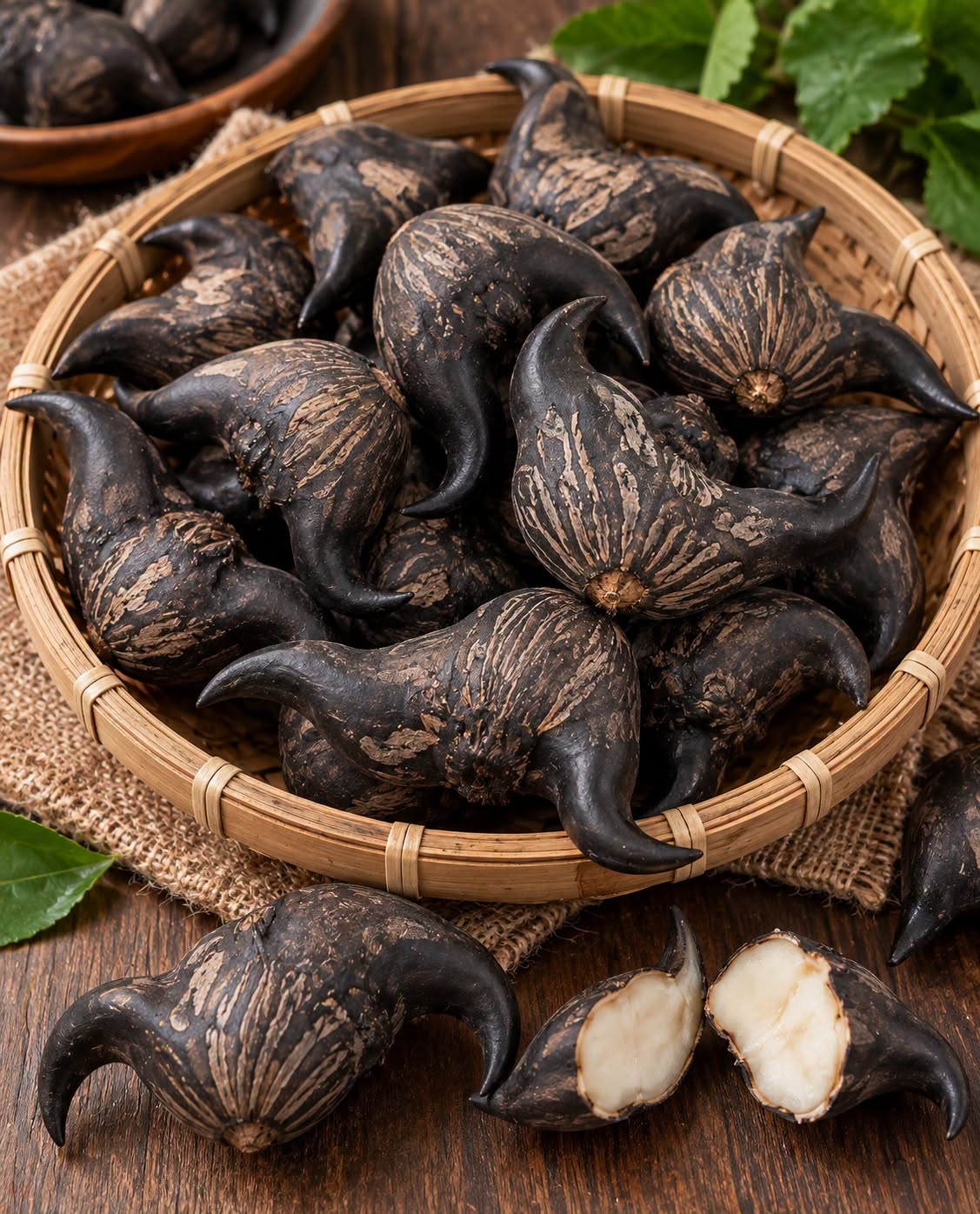
The edible kernel can be eaten by itself after cooking.
It can also appear in soups, rice dishes, porridges, traditional sweets, or savory dishes.
In some regions, people dry and grind the kernels into flour.
This flour can become part of traditional foods and religious fasting dishes.
The contrast between shell and kernel makes water caltrops especially memorable.
Outside, they look hard, dark, and almost threatening.
Inside, the food looks surprisingly ordinary.
However, only the interior kernel is eaten.
The shell remains tough and inedible.
Therefore, anyone preparing water caltrops needs to remove the shell carefully after cooking.
The points can remain sharp, so rushing the process is not a good idea.
Water Caltrops Are Not the Same as Regular Water Chestnuts
Similar Names Hide Important Botanical Differences
One of the biggest sources of confusion involves the name “water chestnut.”
People sometimes use that term for water caltrops, but the familiar Chinese water chestnut is a completely different plant.
Chinese water chestnuts come from Eleocharis dulcis.
They grow as underground corms attached to an aquatic sedge.
Those corms are usually round and smooth.
They are the crisp white pieces commonly found in many stir-fries and other dishes.
Water caltrops, on the other hand, belong to the genus Trapa.
They produce fruits with hard shells and distinctive horn-like projections.
Therefore, the two foods may share a common nickname, but they differ botanically and visually.
Traditional tree-grown chestnuts are different again.
Chestnuts grow on trees and develop inside spiny husks.
Their brown shells look nothing like the dark, angular structure of a mature water caltrop.
This naming confusion can make online identification more difficult.
A person might search for “water chestnut” and see several completely different foods.
For practical purposes, look at the physical structure.
A horned, dark aquatic fruit usually points toward water caltrop.
A smooth, rounded corm points toward Chinese water chestnut.
Understanding that difference matters because preparation methods may not be identical.
You should never assume that instructions for one food automatically apply to another simply because people use similar names for them.
Regional Names Can Add Even More Confusion
Water caltrops have been used in different food traditions for generations.
As a result, they carry many local names.
In parts of South Asia, people commonly know some varieties as singhara.
Elsewhere, names may refer to the horned shape or aquatic growing habit.
This naming variety reflects cultural history, but it can make identification harder for someone seeing the fruit for the first time.
One person may confidently call it a buffalo nut.
Another may call it a water chestnut.
A third may recognize it only as singhara.
All three could refer to a similar Trapa fruit.
The exact species can still differ.
That is why appearance, local knowledge, and source matter more than a single common name.
If someone gives you a bag of these fruits, ask where they came from.
Were they bought at a produce market?
Were they harvested from a pond?
Were they collected in the wild?
Does the person who gave them to you know the local name?
Those details can help establish whether the fruit is a familiar food in your area.
If the source remains uncertain, avoid eating it until someone qualified can confirm the identification.
That caution applies to any unfamiliar plant.
A social media comment can provide a useful clue, but it cannot guarantee safety.
