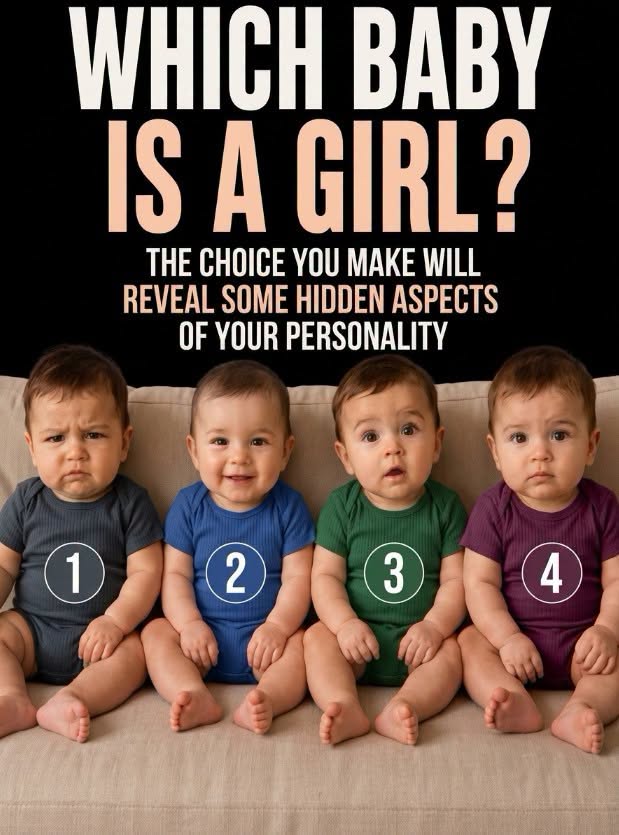
If You Chose Baby #3: The Independent Thinker
Baby #3 may stand out to people who enjoy choosing differently from the crowd.
Perhaps you noticed something unusual about the baby’s posture, facial expression, or position. Alternatively, you may have deliberately questioned the choice that seemed most obvious.
If so, you may have an independent way of processing information.
Independent thinkers often dislike accepting conclusions simply because everyone else believes them. Instead, they prefer to examine the situation personally.
See also 5 Warning Signs of Cancer Developing in the Body You Should Know
You might ask, “What if the obvious answer is deliberately misleading?”
That question can make puzzles especially entertaining.
You may also enjoy unusual solutions. Rather than following the first visual clue, you might search for something others have overlooked.
This habit can help in real-life situations.
For example, independent thinkers often contribute alternative ideas during group discussions. They may notice weaknesses in popular opinions or identify solutions that nobody else considered.
However, independence does not mean opposing everyone automatically.
Sometimes the common answer really is the best one. Therefore, strong independent thinking involves questioning assumptions while remaining open to evidence.
The four-babies puzzle offers a perfect opportunity to practice that balance.
If you chose Baby #3 because the answer seemed less predictable, notice that reasoning.
Did you intentionally avoid the most obvious choice?
Did you spot a detail that seemed unique?
Or did Baby #3 simply attract your attention first?
Your reason matters more than any playful personality label.
After all, a single image cannot scientifically define your personality.
Still, noticing how you approach uncertainty can encourage useful self-reflection.
If Baby #3 was your choice, you may simply enjoy looking beyond the expected answer.
If You Chose Baby #4: The Practical Analyzer
If you selected Baby #4, you may approach visual challenges with a practical mindset.
Rather than focusing mainly on feelings, you may have searched for the most concrete clue you could find.
Perhaps you studied the baby’s clothing, body position, hair, or physical details. You may have mentally compared each option before deciding which one seemed most likely.
Practical thinkers often prefer information they can see and evaluate.
Instead of relying entirely on intuition, they may look for recognizable patterns.
This approach can help with planning, problem-solving, and everyday decisions. For example, you may prefer clear instructions, realistic goals, and useful information over vague possibilities.
However, this particular puzzle creates an interesting trap for practical reasoning.
None of the obvious visual features can reliably establish whether a baby is male or female.
Therefore, even a careful comparison may leave you without enough evidence.
That uncertainty can feel frustrating, especially if you prefer clear answers.
Yet learning to recognize when information is insufficient represents an important thinking skill.
Sometimes the smartest conclusion is not “I know.”
Instead, it is “I cannot determine that from what I can see.”
If you chose Baby #4, consider whether you normally search for concrete answers.
Do you enjoy solving problems logically?
Do you feel uncomfortable when questions have no clear solution?
Or do you simply enjoy narrowing possibilities until one seems strongest?
Those tendencies can explain why Baby #4 stood out.
Again, the choice does not define your personality. However, it may offer a fun glimpse into the way you approach visual uncertainty.
What This Psychological Test Can Actually Tell You
Appearance Cannot Reliably Reveal a Baby’s Sex
Here is the most important takeaway from the puzzle: you cannot reliably determine whether one of the four babies is a little girl based only on appearance.
Babies do not come with universally recognizable visual markers that let strangers determine sex from a photograph.
Hair length does not provide a reliable answer.
Neither does clothing.
Facial shape does not provide certainty either.
Likewise, expressions, gestures, posture, and perceived softness or toughness do not establish whether a baby is male or female.
Many of the clues people use come from cultural expectations.
For example, some people associate certain colors with girls and other colors with boys. Yet those associations change between cultures and historical periods.
Hair and clothing styles also reflect family choices rather than biological facts.
Therefore, a puzzle that asks you to identify a little girl from visual appearance often works by testing assumptions more than observation.
That does not make it pointless.
In fact, recognizing the limitation can make the puzzle more interesting.
You may discover how quickly you associated a particular feature with gender. Then you can ask yourself where that association came from.
Did you learn it from family?
Movies?
Advertising?
Childhood experience?
Social expectations?
Once you notice those connections, the puzzle becomes more than a guessing game.
It becomes an example of how people transform visual details into conclusions.
That process happens constantly in everyday life.
Therefore, the most thoughtful answer may simply be that the image alone does not provide enough reliable information to know which baby is a girl.
See also The First Three Colors You See May Reveal How You Intimidate Others
The Real Value Comes From Noticing How You Think
Despite its title, this challenge is not a genuine psychological test.
It cannot diagnose your personality, measure intelligence, or reveal hidden traits with scientific accuracy.
However, it can still provide a useful moment of self-reflection.
The value lies in noticing your own decision-making process.
Did you choose instantly?
Did you compare every baby?
Did you change your mind after looking again?
Did you rely on emotional impressions?
Did you search for physical clues?
Those questions can tell you something about your approach to visual problems, even though they cannot generate a formal psychological profile.
For example, some people enjoy intuitive decisions. They see an image and trust their first impression.
Others prefer analysis. They examine every option before making a choice.
Neither style always wins.
Intuition can save time when familiar patterns matter. Meanwhile, analysis becomes valuable when a decision requires careful evidence.
The strongest thinkers often know when to use each approach.
This little puzzle also reminds us to separate observations from assumptions.
You may accurately observe that one baby has longer hair. However, concluding that longer hair means the baby must be a girl adds an assumption.
Recognizing that difference can sharpen critical thinking.
Therefore, enjoy the challenge for what it offers: a quick mental exercise that encourages curiosity.
Share it with friends or family and compare answers. The discussion may become more entertaining than the puzzle itself.
You may discover that four people can look at one image, see the same babies, and still build four completely different explanations.
That is what makes simple visual challenges surprisingly fascinating.
Frequently Asked Questions
1. Which of the four babies is actually the little girl?
You cannot reliably identify a baby’s sex from appearance alone unless the original image creator provides verified information about the children. Hairstyles, expressions, clothing, and facial features do not provide dependable proof. Therefore, any answer based only on the picture remains a guess.
2. Does choosing Baby #2 mean I am more empathetic?
Not scientifically. Choosing Baby #2 may provide a fun opportunity to think about whether you focused on facial expression or emotional cues. However, one visual puzzle cannot accurately measure empathy or diagnose a personality trait.
3. Are psychological picture tests accurate?
Some professionally designed psychological assessments use carefully validated methods, but viral picture puzzles usually do not meet those standards. Most online visual personality tests work best as entertainment and conversation starters rather than scientific evaluations.
4. Why do different people choose different babies?
People naturally focus on different visual details. One person may notice hair, while another focuses on clothing, posture, or facial expression. Previous experiences and learned cultural associations can also influence which option seems most convincing.
5. What is the best way to approach puzzles like this?
Enjoy them with curiosity rather than treating the result as a diagnosis. Pay attention to what you noticed first, question your assumptions, compare your reasoning with other people’s answers, and remember that some visual puzzles intentionally leave out enough information to create uncertainty.
Conclusion
Psychological Test: Which of These Four Babies Is a Little Girl? sounds like a challenge with one obvious answer, but its real appeal comes from the way people reach different conclusions.
Maybe you chose Baby #1 because you noticed small details.
Perhaps Baby #2 caught your attention because you focused on expression and emotion.
You might have selected Baby #3 because you questioned the obvious choice, or Baby #4 because you searched for concrete visual clues.
Each choice can inspire a playful discussion about observation and decision-making.
However, the image cannot reliably tell you whether one baby is male or female. Facial features, hair, clothing, expressions, and posture do not provide enough information to establish that fact.
Therefore, treat the personality interpretations as entertainment rather than scientific conclusions.
The most valuable part of the challenge involves noticing how quickly your mind builds a story from limited information.
That insight applies far beyond a picture of four babies.
Every day, people make fast judgments based on appearances, first impressions, and familiar patterns. Sometimes those instincts help. At other times, they can mislead us.
So, look at your original choice one more time.
Did you notice something genuinely meaningful, or did your mind fill in the missing information?
Either way, you just discovered why such a simple visual puzzle can keep people talking.
