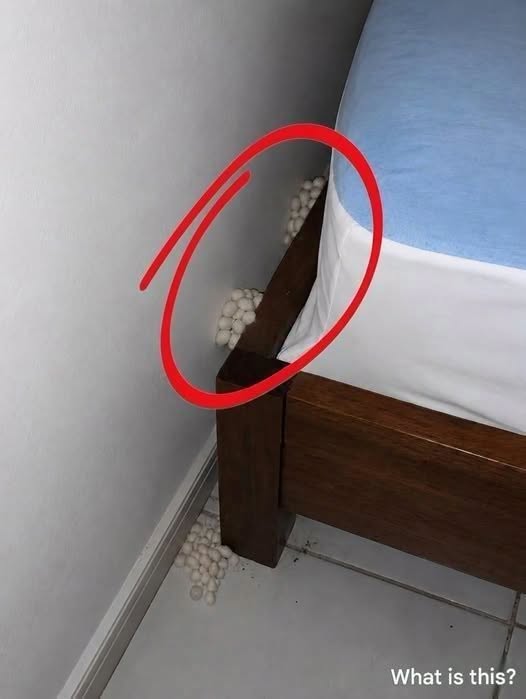
Imagine reaching underneath your bed to retrieve something and discovering several tiny, pale, oval objects tucked into a dark corner.
They look almost like miniature eggs—white or cream-colored, firm, and slightly chalky.
Your first question is probably obvious:
What on earth laid those under my bed?
In warm climates especially, one surprisingly common explanation is house gecko or small lizard eggs. But appearance alone isn’t enough for a definite identification. Several household visitors can leave eggs, cases, cocoons, or other objects that look remarkably similar from a distance.
Here’s how to narrow down the possibilities—and what to do if you find them.
🦎 Possibility #1: House Gecko Eggs
If the objects are small, white, oval, and relatively hard or chalky, gecko eggs are one possibility worth considering.
House geckos often live remarkably close to humans. They hide behind furniture, appliances, curtains, wall openings, and other sheltered locations during the day and emerge at night to hunt insects.
When laying eggs, females generally look for protected places where the eggs are unlikely to be disturbed.
Depending on the species, eggs may be deposited in cracks, behind furniture, inside cabinets, beneath objects, or in other concealed areas.
What Gecko Eggs Can Look Like
Look for objects that are:
- White to cream-colored
- Small and oval or nearly round
- Firm rather than soft and gelatinous
- Sometimes chalky in appearance
- Hidden in a sheltered location
Some gecko species commonly lay only one or two eggs at a time, although communal nesting can result in multiple eggs accumulating in one location.
So finding a larger cluster doesn’t necessarily mean one lizard produced them all at once.
🪳 Could They Be Cockroach Eggs?
This is one of the first concerns many people have—but cockroach egg cases generally look quite different.
Cockroaches produce structures called oothecae.
Rather than looking like smooth white eggs, an ootheca is typically:
- Brown, reddish-brown, or tan
- Elongated
- Capsule-like
- Often ridged along one edge
Depending on the species, they can resemble a tiny purse, bean, or rectangular capsule.
So if the objects are genuinely white, smooth, and chalky, classic cockroach egg cases become a less convincing match.
That said, household pests vary, so photographs or professional identification are preferable to relying on color alone.
